Shrink Film Guide: POF vs PE vs PVC for Your Products

For most products, POF (polyolefin) is the best shrink film: it is strong, glossy, food-safe and runs cleanly on modern machines. Choose PE (polyethylene) for heavy bundles like water packs, and treat PVC as a legacy option that survives mainly in low-cost non-food uses. The right film depends on your product weight, appearance needs and food-contact requirements.
Key takeaways
- POF is the default for retail, food, cosmetics and pharma packs — clear, tough and odour-free.
- PE is for weight: bottled-water bundles, bulk and industrial packs where strength beats sparkle.
- PVC is cheap and shrinks at low heat, but fumes and food-contact concerns are pushing it out.
- Film and machine settings are a pair — changing film means re-tuning temperature and belt speed.
- Buying film and machine from aligned specifications avoids the most common shrink-quality complaints.
Which shrink film is best for your product?
Ask three questions: Does the film touch food or pharma products? How heavy is the pack? And how much does shelf appearance matter? Food contact points to POF. Heavy multipacks point to PE. If neither applies and cost rules, PVC still exists — but read its section before choosing it.
When should you use POF shrink film?
POF is the versatile all-rounder and what we recommend for most new lines. It is strong even in thin gauges (saving film cost per pack), shrinks to a brilliant glossy finish, contains no chlorine, and is approved for direct food contact — which matters across food processing and pharma packaging.
- Best for: food boxes, sweets and namkeen packs, cosmetics, stationery, toys, software/media, pharma cartons, retail multipacks.
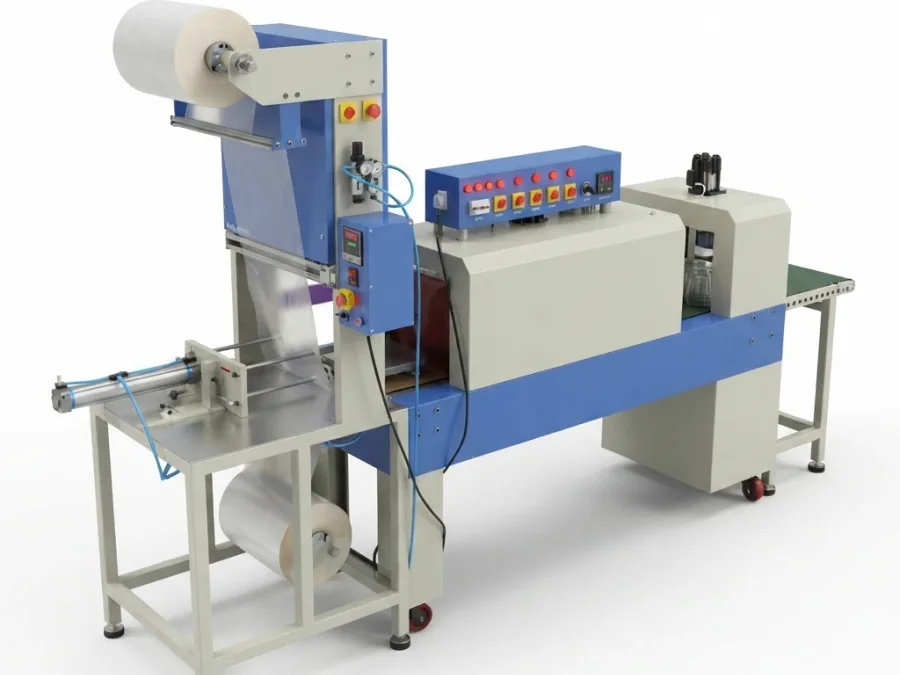
- Runs on: L-sealers and auto web sealers paired with a shrink tunnel.
- Watch: needs accurate mid-range tunnel temperatures and good airflow for a crease-free finish.
When should you use PE shrink film?
PE is the workhorse for heavy and bulky products. It is thicker, highly puncture-resistant and cheaper per kilogram of protection for large items, which is why every bottled-water and beverage bundle you see is PE-wrapped. The trade-offs are a hazier finish and higher heat energy needed to shrink it.
- Best for: 12–24 bottle water bundles, oil tins, detergent packs, bricks of pouches, industrial components.
- Machine note: PE needs a tunnel with higher heat capacity and robust conveyors for the extra weight — mention PE upfront when you request a machine quote.
Is PVC shrink film still worth using?
Sometimes, but less every year. PVC shrinks at lower temperatures (saving some energy), holds print well and costs little. Against that: it releases irritating fumes at the sealing wire that need ventilation, becomes brittle in cold storage, and is unsuitable for direct food contact. Many FMCG brands have already migrated to POF, and export buyers increasingly refuse PVC on sustainability grounds. Our advice: do not build a new food or export line on PVC.
POF vs PE vs PVC: comparison table
| Property | POF | PE | PVC |
|---|---|---|---|
| Clarity & gloss | Excellent | Moderate/hazy | Good |
| Strength (thin gauge) | High | Highest (thick gauge) | Low–moderate, brittle when cold |
| Shrink temperature | Medium | High | Low |
| Direct food contact | Yes | Grades available | Not recommended |
| Fumes at sealing | Minimal | Minimal | Noticeable, needs ventilation |
| Relative cost | Medium | Low per kg of protection | Lowest |
| Typical uses | Retail, food, pharma, cosmetics | Water/beverage bundles, bulk packs | Non-food boxes, low-cost wraps |
How does film choice change machine settings?
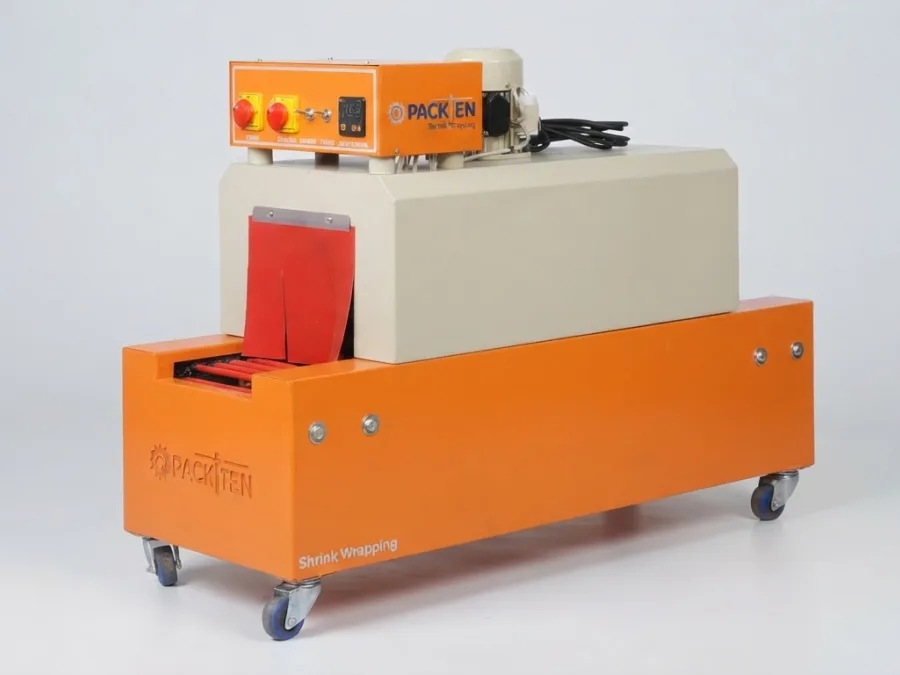
Every film has a shrink window — the temperature band where it tightens evenly without burning or fish-eyes. POF wants steady mid-range heat and strong air circulation; PE wants a hotter chamber and slower belt; PVC wants gentle heat and quick transit. When Packten commissions a line we tune tunnel temperature, airflow and belt speed to your exact film and pack, so you start at low wastage instead of discovering settings by trial. If you are still selecting the machine itself, start with our guide on how to choose a shrink tunnel.
How do you calculate the film size for your pack?
- Measure the pack: length (L), width (W), height (H) in mm.
- Centre-fold film width ≈ W + H + 50–70 mm allowance.
- Cut-off length per pack ≈ L + H + 60–80 mm allowance.
- Pick the thinnest gauge that survives your handling chain — thinner film means more packs per roll.
- Trial on the actual machine before committing to bulk film purchase.
Unsure which film your product needs? Send your pack details through the contact page — our engineers will recommend the film-and-machine combination together, so seals, shrink and running cost are right from day one.
Frequently asked questions
POF (polyolefin) in a certified food-contact grade is the standard choice: it is chlorine-free, odourless, strong in thin gauges and shrinks to a glossy retail finish. Food-grade PE suits heavy bundles like bottled water. PVC is not recommended for direct food contact and is fading from food applications.
Often yes mechanically, but not at the same settings — PE needs a hotter chamber and slower belt than POF, and heavy PE bundles need stronger conveyors. If you plan to run both, say so when specifying the machine so the heating capacity and controls cover both shrink windows properly.
Use the thinnest gauge that survives your handling chain. Light retail packs commonly run thin POF gauges, while heavy multipacks need thicker PE. Thinner quality film usually beats cheap thick film on cost per pack because you get more packs per roll — trial on your actual machine before bulk purchase.
The usual causes are temperature outside the film's shrink window, uneven airflow in the chamber, belt speed too high for the pack, or film gauge mismatched to the product. Start by verifying actual chamber temperature against the set point — sensor drift quietly causes most "sudden" shrink-quality problems.