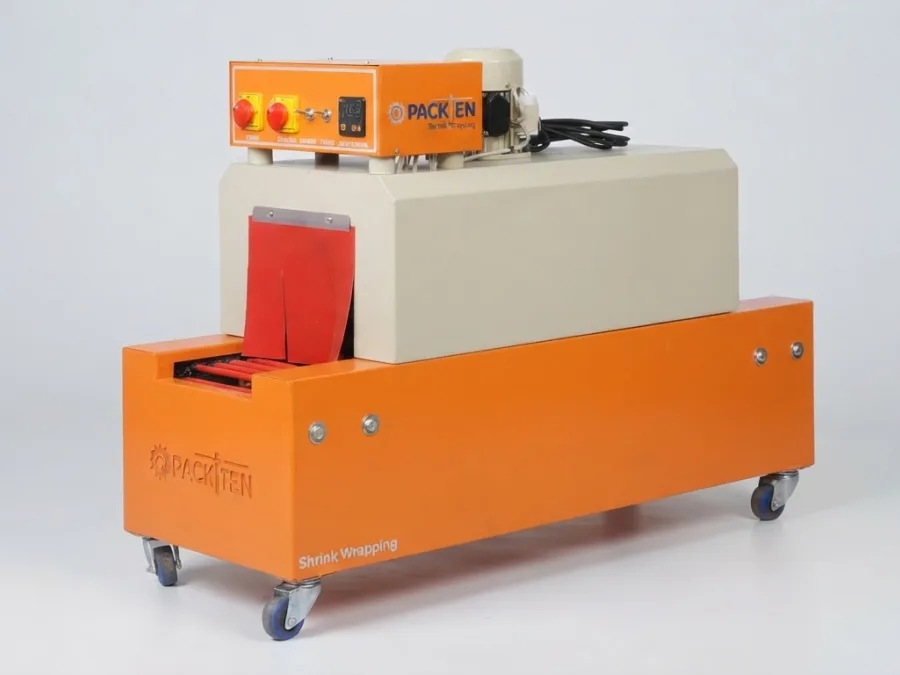
A Shrink Tunnel Maintenance Checklist to Cut Downtime

A shrink tunnel needs about five minutes of daily care, a fifteen-minute weekly inspection and a monthly preventive routine. Follow that cycle and most tunnels run for years without unplanned stoppages; skip it and the usual failures — worn belts, tired heaters, clogged airflow — arrive mid-shift, when they cost the most.
Key takeaways
- Most shrink tunnel breakdowns are preventable with a simple daily/weekly/monthly routine.
- Film scraps on the belt and dust in the airflow are the two biggest silent killers of shrink quality.
- Keep fast-wearing spares (belt, heaters, fan bearings) in stock — a ₹-small part can stop a full line.
- Log every check; trends in the log predict failures before they happen.
- If the tunnel is critical to dispatch, an annual maintenance contract moves the whole burden to scheduled visits.
How often should you service a shrink tunnel?
Daily checks by the operator, weekly checks by the line supervisor, monthly preventive tasks by maintenance staff, and a professional service inspection every 6–12 months depending on shifts. A tunnel running two or three shifts in a dusty plant needs the shorter end of every interval.
Daily checks (5 minutes, operator)
- Wipe the conveyor and chamber entry/exit; clear film scraps off the belt and rollers.
- Confirm the tunnel reaches and holds its set temperature before starting production.
- Listen for new fan or motor noise — bearings announce themselves early.
- Check the first packs of the shift for even shrink; wrinkles or cold spots mean airflow or temperature drift.
- Verify the emergency stop works.
Weekly checks (15 minutes, supervisor)
- Inspect the conveyor belt for edge wear, cuts and tracking drift; re-centre if it walks to one side.
- Open and clean air-circulation fans, vents and filters — dust here directly degrades shrink quality.
- Check chamber curtains (if fitted) for tears that leak heat.
- Inspect the upstream sealer's wire/blade and pads, since a bad seal shows up as a bad shrink. Our L-sealer owners find most "tunnel problems" start at the sealer.
- Tighten any conveyor chain or drive tension per the manual.
Monthly and quarterly tasks (maintenance staff)
- Inspect heating elements and their wiring/terminals for discolouration or looseness.
- Verify temperature-sensor reading against an external probe; recalibrate if drifted.
- Lubricate conveyor bearings and drive components per the schedule.
- Check panel connections, contactors and earthing.
- Review spare-part stock against the list below and reorder before you run out.
Which spares should you keep in stock?
| Part | Failure warning sign | Typical replacement cycle |
|---|---|---|
| Conveyor belt / mesh | Frayed edges, tracking drift | 12–24 months |
| Heating elements | Longer heat-up time, uneven shrink | 12–36 months |
| Fan motor bearings | Rising noise, vibration | 12–24 months |
| Temperature sensor / thermocouple | Set-point vs actual drift | As indicated by calibration |
| Sealer wire & PTFE tape (upstream) | Weak or burnt seals | Weeks–months by usage |
Packten stocks these consumables for our machines and ships fast through our spares and rapid service desk, so a worn part never becomes a lost day of dispatch.
When should you call a service engineer instead of fixing in-house?
Handle cleaning, belt tracking and scheduled lubrication in-house. Call the manufacturer for anything electrical inside the panel, heater replacements, sensor calibration and repeated temperature instability — guessing at these costs more than the visit. Well-maintained machines age remarkably slowly: one of our food customers has run an L-sealer three years near maintenance-free on exactly this routine.
Does an AMC make sense for your plant?
If the tunnel feeds your dispatch every day, yes — scheduled preventive visits, priority breakdown response and planned spares almost always cost less than one bad stoppage in season. We compare the economics honestly in our guide to packaging machine AMCs in India. FMCG plants running multi-shift lines — the profile of most of our FMCG customers — benefit the most.
Want a maintenance plan built for your exact shrink tunnel machine and shift pattern? Reach our service team via the contact page — we support Packten machines and most other makes too.
Frequently asked questions
The usual suspects, in order: one or more heating elements failed (heat-up takes longer and shrink is uneven), the temperature sensor has drifted so the display lies, airflow is choked by dust on fans and vents, or a contactor in the panel is worn. Check elements and sensor first — they cause most cases.
Elements are replaced on condition, not calendar: watch for longer heat-up times, uneven shrink across the belt and visible discolouration. In multi-shift Indian plants that typically means somewhere between one and three years. Keeping a spare set on the shelf turns the failure into an hour's job instead of a lost day.
Daily and weekly care — cleaning, belt tracking, listening for bearing noise — absolutely belongs with operators, and a log makes it stick. Leave panel electricals, heater replacement and sensor calibration to maintenance staff or the manufacturer's engineers; guessing inside the panel costs more than a service visit.
Keep the sealing wire or blade and its PTFE tape clean and replace them as they wear — a degraded seal shows up downstream as a bad shrink and gets blamed on the tunnel. Check pad alignment weekly and keep a spare wire-and-tape kit; it is the cheapest insurance on the line.